Percepção Cutânea
Doris von Drathen
Na sua travessia do Sahara o explorador Sven Lindqvist fez as suas reflexões
sobre o
deserto a partir da lúcida constatação de que o deserto representava pouco mais do que
um efémero interlúdio entre as duas idades do gelo da Europa (1). A Madeira também se
formou num período geologicamente recente de intensa actividade vulcânica. No fim de
contas, o que são quatro milhões de anos comparados com os quatro mil milhões de anos
desde que a terra desenvolveu a sua crosta? Quando voltará esta ilha a ser engolida pelo
oceano que um dia a expeliu do seu interior como uma fonte de lava?
O pintor João Queiroz passou um mês a trabalhar nesta ilha que ele descreve como um
“buraco no oceano”. A Madeira é “a inversão de um buraco — uma montanha muito alta
rodeada por imensas profundidades de água” (2). Embora não tenha especial interesse na
geologia, a sua maneira nada sentimental de abordar a natureza como um inapropriável
facto da vida tem a ver com o sistema mental de um cientista. Ele não oferece nada a que
nos possamos agarrar — ponto de vista do artista, perspectiva do ponto de fuga,
composição pictórica, nem sequer um sinal de adesão a princípios formais ou a proporções
académicas, nada que se possa discernir. O céu e a paisagem podem ser facilmente
invertidos e qualquer definição de topo e fundo parece questionável. As nuvens podem
assumir a aparência de formações montanhosas, enquanto as rochas quase parecem voar, com
espaços de vegetação que se fundem em contornos topográficos, sombras que se transformam
em rastos de velocidade, a luz que adquire peso físico e volumosos penhascos que
simplesmente se desintegram.
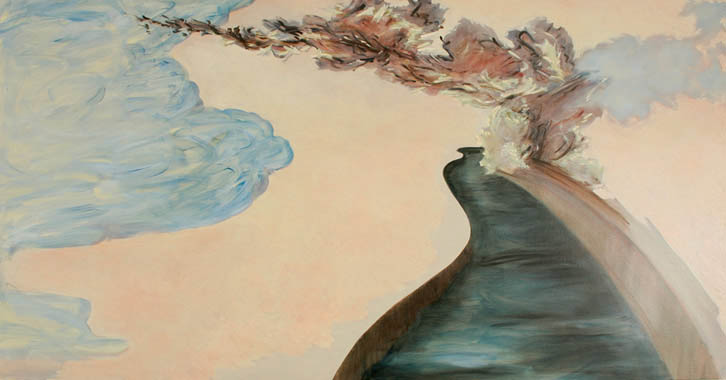
A nossa pele começa a sentir-se desconfortavelmente tensa face à orla cinzento-escura da
montanha que enche toda a tela. Apenas uma fina linha junto à parede superior sugere o
contorno de um céu. Esta massa rochosa parece estranhamente tensa, como se estivesse em
vias de rebentar ou prestes a explodir. As pregas e as fendas na sua superfície sugerem
uma espécie de grande tensão, como se esta massa contivesse algo misteriosamente
obstinado. Esta montanha não é tanto um elemento da natureza mas sobretudo um
acontecimento. Para o observador, a própria pintura não pode ser explorada com os olhos,
mas directamente sentida pela sua pele como algo que estivesse a acontecer — como se a
tela oferecesse uma superfície cujas fronteiras das duas diferentes formas de
experimentar o mundo se interceptassem. Na verdade, como processo a própria pintura é
pele, uma fronteira entre os reinos interior e exterior. Queiroz não pinta a observação
visual, mas a experiência cutânea, a sensação daquilo que jaz sob a superfície. No seu
caso aquilo que vê o mundo não é o olho mas um orgão sensório que “reage directamente,
quando é accionado.” “A pele é análoga `a natureza”, explica ele, pois “a pele
antropológica reage da mesma maneira que a crosta da terra. Cada poro é um orgão visual
— toda a nossa pele é um espaço capaz de conter o mundo. Os nossos olhos, de facto, são
apenas uma forma concentrada deste modo de percepção. Mas a pele tem uma maneira
diferente de ver e não pode permanecer fora do que está a acontecer”. (3)
Como se uma exposição pudesse de algum modo ser verificada e confirmada pela natureza —
esta ideia é familiar, por exemplo, às excursões ao Mont Sainte-Victoire — a galeria que
promove a exposição de Queiroz levou-nos em viagem às montanhas da Madeira. Mas uma vez
lá, seríamos capazes de testemunhar a presença de uma tensa e compacta pele de pedra? As
sombras que caíam e os recortados picos podiam de alguma maneira ser vistos contra o
vasto céu? Mas o que significa o “aller au motif”, agora? Qual é o significado de tal
excursão para o artista, quais são as consequências para o observador? Quando Cézanne
estava a trabalhar na Provença disse um dia: “Estou num tal estado de desordem mental e
tão confuso que receio poder a qualquer momento perder os meus débeis sentidos” A ideia
do tranquilo prazer sentido por um pintor que mergulha na natureza é apenas um dos
chocantes mal-entendidos que se têm perpretado através da crítica de arte burguesa.
Expor-se à realidade não significa mais do que enfrentar a impossibilidade de a agarrar,
mais do que confrontar-se com o seu lado terrível, de gravar um fragmento do mundo no
exacto momento em que se escapa. Queiroz não fala muito sobre os seus sentimentos. Em
vez disso pinta-os, como se ele fosse uma realidade palpável. Vemos o céu sobre uma
colina, como se o céu a empurrasse para baixo, observamos a luz e as manchas de cor
cinzento-escuro afundando-se progressivamente e não encontramos rasto dos dramáticos
pedaços de nuvem mas enormes pesos delineados por negros contornos caindo sobre áreas de
cor acastanhada. Mas, em contraste com Cézanne, as pinturas de Queiroz já não são prova
de uma busca de princípios formais ou de composição de cores no sentido de procurar
“interiormente a essência e as leis da vida natural e do desenvolvimento”. (5) Em vez
disso, testemunhamos um artista impelido para uma forma de pintura que renuncia à ficção
e à definição em favor do movimento reactivo imediato. Queiroz pinta a impossibilidade
de retratar algo. Ele pinta a ilusória tensão entre o que parece ser e o que de facto é.
Ele pinta a súbita sensação de terror que julgávamos firme mas descobrimos que é uma
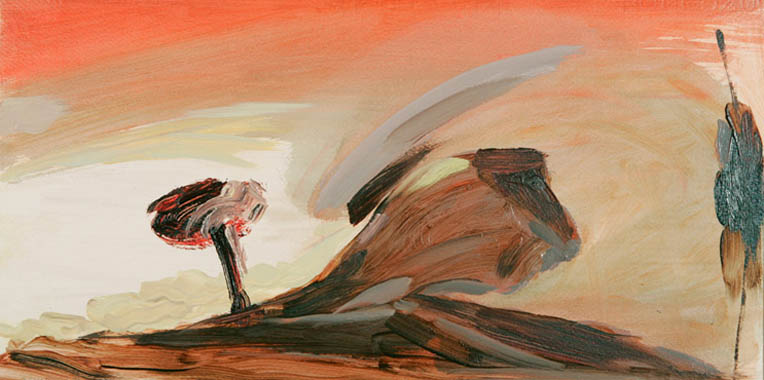
superfície muito instável, escorregadia. Sombras alarmantes levam rochas atrás de si. Os
declives da montanha não são de fiar. Nada está imóvel ou inerte — numa inspecção de
mais perto o que vemos provoca arrepios, pois as longas sombras lançadas pelas pedras
parecem directamente ligadas a um ímpeto de pânico e aceleração. A superfície das rochas
perde a sua massa, o chão é transformado em pura velocidade e a velocidade dos detritos
que caem troça dos nossos passos.
Queiroz não confia no olho nu e desconfia dos padrões convencionais da referência visual
e das suas habituais classificações. Em vez da perspectiva do ponto de fuga ou do ponto
de vista escolhe a secção. É aqui que a física, emocional ou metafórica referência ou
articulação, pode tomar lugar. As sensações percebidas pela pele e a composição das
coisas são conduzidas ao extremo. Mas, seguindo a lógica da abordagem pictórica de
Queiroz o acto de desenhar tem uma mera função atributiva. “Ao desenho falta-lhe pele. É
aí que as coisas convergem, é o momento do seu encontro. O desenho já não tem nada a ver
com as sensações sentidas pela pele. A linguagem separa as coisas em diferentes
categorias — aqui uma praia, ali uma planta, uma sombra ou uma pedra — visto que uma
linha desenhada as liga e faz tudo fluir. Por isso uma sombra transforma-se numa
montanha que se transforma numa planta que se transforma numa pedra que se transforma
num pedaço de luz …” (6) Semelhantes às suas pinturas, os desenhos arrancam-nos do nosso
modo culturalmente familiar de ver a “paisagem” afastando-o das convenções: as praias
parecem ser insondáveis e pouco diferentes de uma miragem. As coisas atiradas à praia,
seja uma pedra ou uma planta de bambu, já não dão um sentido de orientação, mas em vez
disso formam confusos puzzles visuais com as linhas da rebentação e o horizonte. Há
desenhos imbuídos de um sentido de êxtase, com algo etereamente efémero — como se a
imagem mal tivesse sido tocada.
Neste novo ciclo de trabalho Queiroz revela, com um radicalismo até agora raramente
presente, que a sua pintura rompeu com as convenções da cor (compare-se com a afirmação
de Cézanne, “peindre, c’est enregistrer ses sensations colorées”(7)”, substituindo-as
por uma pintura cutânea. A sua abordagem é semelhante à definição de espaço proposta por
Deleuze na sua diferenciação entre “espace strié” (espaço dividido) e “espace lisse”
(espaço aberto); a primeira noção descreve um espaço geométrica e opticamente calibrado,
a segunda denota um espaço definido pelos acontecimentos. A percepção cutânea, diz
Deleuse, apoia-se menos na forma assumida por algum material do que nas energias e
sintomas assinalados por essa questão. Diz mais respeito a um “espaço intenso” do que a
uma extensão espacial. É mais sobre a tensão gerada dentro de um espaço do que sobre as
suas dimensões físicas. O espaço carregado de tensão é determinado por forças dinâmicas
como o vento ou o som, como o eco ruidoso que se solta quando uma enorme placa de gelo
se quebra ou o zumbido do vento quando este redemoinha ao longo de vastas dunas de
areia(8). Queiroz recusa-se a escolher uma forma de percepção de preferência a outra.
Sempre que se expõe à natureza reabre um intenso diálogo como se estivesse a sujeitar-se
pela primeira vez a esta aventura. Ele é um daqueles artistas que coloca a mais simples
das questões — para as quais pode não haver resposta. Quando os outros perguntam, “Quem
sou eu?” ou “Onde estou eu?”, tudo o que ele quer saber é, “O que é isto?”. Ele
recusa-se persistentemente a aceitar coisas do género “pontes conceptuais”(9) e
“caminhos de fuga”(10) que nos habituámos a usar como uma maneira de avançar na
realidade: “Pintar o mundo exterior interessa-me tão pouco como traduzir um mundo
interior — eu não transporto uma paisagem interior comigo. Em vez disso, o que realmente
me interessa é a existência das coisas como acontecimento daquilo que existe. Eu não
governo a natureza nem a transformo em paisagem mas, sim, claro que desempenho um papel
dominante no modo como esses acontecimentos são relatados. Mais do que criar distância
entre mim e o mundo, o meu desenho participa do mundo como um equivalente, como um
terceiro ser, por assim dizer.”(11)
O dragoeiro contém uma seiva vermelho-vivo chamada “sangue de drago”. Queiroz extrai
alguma desta seiva, mistura-a com álcool e desenha com ela. Na exposição um quarto
inteiro está coberto com estas telas sem moldura. Se entrarmos desprevenidos neste
quarto é provável que nos provoque um tremendo choque. Não por causa dos desenhos em
sangue-vivo, mas por ficarmos frente a frente com a urgência que se prende ao material a
ao motivo. A autenticidade de um nómada não se constitui unicamente através da vida que
leva no grande espaço entre várias pastagens, nem apenas através do facto de ele estar
de passagem num território que não ocupa. Mais, o que define o nómada é sobretudo o
trabalho que faz; por outras palavras, ele vive dos produtos dos animais que guarda,
habitando a lã que eles lhe dão. O que significa que a segunda pele do nómada não é mais
do que o seu trabalho(12). Da mesma maneira, a par das suas pinturas, os desenhos também
constituem “a segunda pele do pintor”. Em sentido mais elevado estes desenhos são prova
de uma abordagem deliberada, de uma decisão de estar na natureza mais do que estar
diante da natureza, atitude essa que forma a base de todos os trabalhos de Queiroz. O
que isto sugere é a preferência por uma maneira diferente de ver em oposição ao
apropriar-se: Queiroz prova que o olho não pode ser concebido fora da margem do campo de
visão. A sua pintura reclama a nossa atenção para uma “pele que vê”, essa “fábrica de
sensualidade” que “fecha o corpo, o cobre e o abre para os sentidos”(13). O pintor
oferece a sua pele a um conhecimento que revela uma intensa experiência de
“estar-no-mundo”(14). Isto não tem nada a ver com a “imitação” da natureza, mas sim com
o encontrar com o complemento Outro que é a natureza: Não é uma questão de sondar as
suas leis mas de examinar a nossa capacidade de entender o Outro. “Em todas estas
(formalistas) noções de criatividade artística, o espírito humano e a natureza são
contrastados em todas as diversas manifestações da sua existência e da sua vida. A
“imitação”, escreve Max Raphael na sua análise de Cézanne, “mascara a distância e a
oposição entre si; por isso impede qualquer análise de e dentro dos métodos
historicamente mutáveis com os quais se correspondem, misturam e conseguem uma unidade,
e ao mesmo tempo acaba por eliminar a singularidade e a autonomia do próprio objecto que
corporiza o resultado da sua mútua interacção — o trabalho da arte” (15). Hoje, quando
João Queiróz pinta (em óleos ou aguarelas) ou desenha “beiras do precipício” (16), as
pessoas respondem em toda a parte com surpresa e perguntam pela natureza — ou até mesmo
pela paisagem — e correm o risco de se esquecerem da inequívoca autonomia destas
imagens. Os seus trabalhos podiam levar-nos a pensar em Nietzsche, que proclamava: “Não
há nenhuma verdade apenas em nome da verdade”. Não existe nenhuma pintura apenas em nome
da pintura: esta é a visão radical que conduz Queiroz à tela.
Na essência, contudo, estas questões deslocam a sua pintura para terrenos ontológicos,
pois de facto, não somos todos perseguidos pelo espectro daquilo que se transformou na
própria máscara que cada um de nós inventou para si? A crosta da terra tem uma espessura
entre 25 e 40 quilómetros. A Madeira é apenas outra peça da perturbadora evidência de
que vivemos as nossas vidas sobre nada mais firme do que uma frágil capa. Durante a sua
estadia lá, João Queiroz pintou não só a ilha mas também um alto conhecimento da
fragilidade do nosso “desamparo”. Mas descobrimos nas suas pinturas estranhos seres que
se recusam à apropriação. Expormo-nos aos seus trabalhos significa pouco mais do que a
boa vontade em despirmos a nossa própria pele.
Tradução de José Agostinho Baptista
(escrito aquando da exposição na Porta 33 de João Queiroz em Novembro de 2000)
1 - Cf. Sven Lindqvist, Desert Divers (Londres, 2000), p.12
(título sueco original: Ökendykarna, 1990)
2 - João Queiroz numa conversa não publicada com o autor;
Madeira, 24 Novembro 2000
3 - Ibid.
4 - Paul Cézanne citado em: Max Raphael, Wie will ein Kunstwerk
gesehen sein? (Frankfurt, 1984), pp. 47-48
5 - Paul Cézanne, ibid, p.15
6 - João Queiroz numa conversa com o autor
7 - Paul Cézanne citado em: catálogo (Paris, 1995), p.37
8 - Cf. Gilles Deleuze, Mille Plateaux (Paris, 1980), p.598
9 - Conceito preferido de Willard van Orman Quine
10 - “Notstege”: em Martin Heidegger, Die Kunst und der Raum (Frankfurt,
1969), p.8
11 - João Queiroz
12 - Amy Milovanov, La seconde peau du nomade, Nouvelles littéraires,
27-7-1978, citado em Gilles Deleuze, p.471
13 - Michel Serres, Les Cinq Sens (Paris,1985), pp.51-55
14 - “In-der-Welt-sein”: Hannah Arendt, Essays über Benjamin und Brecht
(Munique,1971), p.78
15 - Max Raphael, ibid.,p.14
16 - Edmon Jabès, Ça suit son cours (Paris,1975), p.29 “rampantes clôtures”
no poema L’éternité des pierres
Haptic perception
Doris von Drathen
On his trek across the Sahara the explorer Sven Lindqvist elaborated his
meditations on
the desert from the terse realization that it represented little more than a fleeting
interlude between two European ice ages. Likewise, Madeira was formed in a geologically
recent period of intense volcanic activity. What, after all, are a mere four million
years compared to the four thousand million years since the earth developed its crust?
How soon will this island be swallowed back into the ocean that once spat it out from
its interior as a lava fountain?
The painter João Queiroz spent a month working on this island he describes as a ‘hole in
the ocean’. Madeira is ‘the inversion of a hole – a very high mountain surrounded by
extreme depths of water’. Although he pretends no special interest in geology, his
unsentimental manner of approaching nature as an unappropriable fact of life is
reminiscent of a scientist’s mindset. It offers absolutely nothing to cling to –
artist’s viewpoint, vanishing point perspective, pictorial composition, not even a trace
of adherence to formal principles or academic proportions can be discerned. Sky and
landscape could easily be inverted and any assertion of top and bottom seems
questionable. Clouds might assume the appearance of mountain formations, while rocks
seem almost to fly, with stretches of vegetation merging into topographical contours,
shadows changing into trails of velocity, light acquiring material weight and voluminous
cliffs simply disintegrating.
One’s skin begins to feel uncomfortably taut in the face of the dark grey mountain ridge
that fills the entire canvas. Nothing more than a slender line running close to the
picture’s top edge hints at the contour of a sky. This mass of rock seems strangely
charged with tension, as if it were on the verge of bursting or about to explode. The
folds and cracks on its surface suggest a kind of clenched strain, as though this mass
contained something eerily untoward. This mountain is not so much an element of nature
as an event. For the viewer, the picture itself cannot be explored with the eyes, but is
felt directly by his skin as an occurrence – as if the canvas offered a surface where
the boundaries of two distinct modes of experiencing the world intersect. Indeed, as a
process painting itself is skin, a boundary between interior and exterior realms.
Queiroz does not paint visual observation, but haptic experience, the sensation of what
lies beneath the surface. His screen onto the world is not the eye but a sensory organ
that ‘reacts directly’, as he puts it. ‘Skin is analogous to nature,’ he explains,
because ‘anthropological skin reacts similarly to the earth’s crust. Each pore is a
visual organ – one’s entire skin is a boundary capable of taking in the world. Our eyes,
in fact, are nothing more than a concentrated form of this mode of perception. But skin
has a different way of seeing and cannot remain outside what is happening.’
As if the exhibition could somehow be verified and confirmed by nature – this idea is
familiar, for instance, from excursions to Mont Sainte-Victoire – the institution
hosting Queiroz’s exhibition took us on a trip up into the mountains of Madeira. But
once there, were we actually capable of witnessing the event of a clenched, compacted
skin of rock? Cast shadows and jagged peaks could by all means be seen against the vast
sky. Yet what does ‘aller au motif’ actually mean? What is the significance of such an
excursion to the artist, what are the consequences for the viewer? While Cézanne was
working in the Provence he once remarked: ‘I am in such a state of mental disarray and
such great confusion that I fear I might at any moment lose my weak senses.’ The idea of
the tranquil pleasure experienced by a painter going out into nature is just one of the
shocking misconceptions to have been perpetrated by bourgeois art appreciation. Exposing
oneself to reality surely means nothing other than facing the impossibility of grasping
it, nothing other than confronting its awesomeness and recording a fragment of the world
in the very moment it slips away. Queiroz says little about his feelings. He paints them
instead, as if he were skinning reality. We see the sky above a hill, as though it were
pressing it down, observe light and grey-black patches of colour progressively merging,
find no trace of dramatic scraps of cloud but ponderous weights lined with black
contours bearing down on expanses of brownish colour. In contrast to Cézanne, however,
Queiroz’s paintings no longer offer evidence of a search for formal or colour
compositional principles in the sense of seeking ‘insight into the essence and laws of
natural life and development’. Instead, we witness an artist propelled towards a form of
painting that relinquishes fiction and definition in favour of immediate reactive
movement. Queiroz paints the impossibility of picturing something. He paints the
deceptive tension between what appears to be and what actually is. He paints the sudden
sense of terror derived from setting foot on a terrain that one assumed to be firm
ground, only to discover that it is a very unsteady, slippery surface. Alarming shadows
tow rocks behind them. Mountain slopes are not to be trusted. Nothing is stationary or
inert – on closer inspection what you see makes your flesh creep, for the long shadows
thrown by the stones seem to be directly linked to a rush of panic and acceleration. The
surface of the rocks loses its massiveness, the ground is transformed into pure velocity
and the speed of the falling scree mocks your steps.
Just as Queiroz mistrusts the naked eye, he also wary of the conventional frames of
visual reference and their customary classifications. In lieu of the vanishing point or
viewpoint perspective he chooses the section. This is where physical, emotional,
metaphorical reference or articulation can take place. Sensations perceived by skin and
the composition of things are both driven to the extreme. Yet, following the logic of
Queiroz’s pictorial approach the act of drawing has a merely attributive function: ‘A
drawing lacks skin. It is where things converge, it is the moment of their encounter.
Drawing no longer has anything to do with the sensations felt by the skin. Language
separates things into different categories – here a beach, there a plant, a shadow or a
rock – whereas a drawn line links them up and makes everything flow. Hence a shadow
turns into a mountain which turns into a plant which turns into a stone which turns into
a patch of light…’ Similar to his paintings, the drawings wrench our culturally familiar
way of seeing ‘landscape’ away from conventions: beaches appear to be fathomless and
barely discernible from a fata morgana. Things washed up on the shore, a stone maybe, or
some bamboo plant, no longer offer a sense of orientation, but instead play confusing
visual puzzles with the lines of the surf and the horizon. There are drawings which are
imbued with a sense of ecstasy, with something airily ephemeral – as if the image had
barely been touched.
In this new cycle of work Queiroz shows with hitherto seldom achieved radicalism that his
painting in nature has broken with the conventions of colour composition (compare with
Cézanne’s assertion, ‘peindre, c’est enregistrer ses sensations colorées’), replacing
them instead with haptic painting. His approach is similar to the definition of space
proposed by Deleuze in his differentiation between ‘espace strié’ (partitioned space)
and ‘espace lisse’ (open space); the first notion describes a geometrically and
optically calibrated space, the second denotes space as defined by events. Haptic
perception, Deleuze argues, relies less on the form assumed by some material phenomenon
than on the energies and symptoms signalled by such matter. It concerns a ‘spatium
intense’ rather than a spatial expanse. It is about the tension generated within a space
rather than its physical dimensions. Space charged with tension is determined by dynamic
forces such as wind or sound, like the hurtling echo unleashed when a huge sheet of ice
cracks or the purring whirr of wind as it eddies across vast sand dunes. Queiroz refuses
to choose one form of perception in preference to another. Each time he exposes himself
to nature he reopens an intense dialogue as if he were subjecting himself to this
adventure for the very first time. He is one of those artists who pose the simplest of
questions – for which there can be no answer. Just as others ask, ‘Who am I?’ or ‘Where
am I?’, all he wishes to learn is, ‘What is it?’ He persistently refuses to accept the
kinds of ‘conceptual bridges’ and ‘paths of escape’ we have grown used to as a means of
muddling through reality: ‘Depicting the outer world interests me just as little as
translating some inner world – I do not carry an ‘inner landscape’ around with me.
Instead, what really interests me is the occurrence of things as events, of what is
actually there. I do not govern nature or turn it into landscape but, yes, of course I
play a dominant role in how these events are related. Rather than putting distance
between me and the world, my drawing participates in the world as an equivalent, as a
third being so to speak.’
The dragoeiro tree contains a blood-red sap called ‘sangue de drago’. Queiroz bleeds out
some of this sap, mixes it with alcohol and draws with it. In the exhibition an entire
room is papered edge to edge with these unframed sheets. If you enter this room unawares
it is likely to give you a severe shock. Not because of the blood-red drawings, but by
being brought face-to-face with the immediacy with which material and motif are linked.
A nomad’s authenticity is not constituted merely by the life he spends in the great
in-between as he oscillates between various pastures, nor simply by the fact that he is
constantly passing through rather than occupying territory. Rather, the defining feature
of the nomad is above all that he lives in his work; in other words, he lives off the
products of the animals that he keeps, he inhabits the wool that they give him. Which
means that the nomad’s second skin is nothing other than his work. In the same vein, in
addition to his paintings, drawings also constitute ‘the painter’s second skin’. For in
a heightened sense these drawings offer evidence of a deliberate approach, the decision
to be in nature rather than just standing in front of nature, an attitude that forms the
basis of all Queiroz’s works. What this suggests is the preference for a different way
of seeing as opposed to appropriation: Queiroz proves that the eye cannot conceivably be
located out on the margin of the field of vision. His painting sharpens our awareness
for a ‘seeing skin’, that ‘fabric of sensuality’ which ‘seals the body, covers it and
opens it up for the senses’. The painter gives his skin for an awareness that brings
about an intense experience of ‘being-in-the-world’. This has nothing to do with
‘imitating’ nature, but with encountering the completely Other that is nature. This is
not a question of fathoming its laws but about examining one’s own capacity to perceive
the Other. ‘In all these (formalistic) notions of artistic creativity, the human spirit
and nature are contrasted in all the varied manifestations of their existence and life.
Imitation,’ Max Raphael writes in his analysis of Cézanne, ‘masks the distance and the
opposition between them; it thereby hampers any analysis of and insight into the
historically changing methods through which they correspond, intermingle and achieve a
unity, and at the same time ultimately eliminates the singularity and autonomy of the
very object that embodies the result of their mutual interaction – the work of art.’
Today, when João Queiroz paints (in oils or watercolours) or draws nature’s ‘precipitous
edges’, people on all sides respond with surprise and ask about nature – or even
landscape – and run the danger of forgetting about the unmistakable autonomy of these
images. His works could prompt us to think of Nietzsche, who claimed, ‘There is no truth
for truth’s sake alone’. There is no picture for the picture’s sake alone: this is the
radical view with which Queiroz approaches the canvas.
In essence, however, these issues shift his painting onto ontological terrain, for
surely, are we not all haunted by the spectre of actually becoming the very mask that
each of us has invented for ourselves? The earth’s crust is between 25 and 40 kilometres
thick. Madeira is just another piece of unsettling evidence that we live our lives on
nothing sturdier than a frail cover. During his stay there João Queiroz painted not only
the island but also a heightened awareness for the fragility of our ‘dereliction’. Yet
we encounter his pictures as alien beings that refuse to be appropriated. To expose
oneself to his works means little less than a willingness to shed one’s own skin.
Translated by Matthew Partridge
Haptisches Sehen
Doris von Drathen
Als der Forscher Sven Lindquist die Sahara durchquert, knüpft er seine
Reflexionen an die
lapidare Feststellung, die Wüste sei kaum mehr als eine Epeisode zwischen zwei
europäischen Eiszeiten. Madeira stammt aus der jungvulkanischen Ära. Was sind vier
Millionen Jahre im Vergleich zu viertausend Millionen Jahren seit dem Bestehen der
Erdhaut ? Wann wird die Insel wieder vom Ozean verschluckt, der sie als Lavafontäne aus
seinem Innern hat hervorbrechen lassen?
Einen Monat lang arbeitet der Maler João Queiroz auf dieser Insel, die er ein „Loch im
Ozean“, nennt, „die Umkehrung von einem Loch; ein sehr hoher Felsen umgeben von extremer
Wassertiefe.“ Er hat zwar nicht speziell ein Interesse an Geologie, aber seine
unsentimentale Art, sich der Natur als einer unvereinnehmbaren Gegebenheit zu nähern,
erinnert an die Haltung eines Forschers. João Queiroz malt eine unbequeme Natur. Kein
Halt nirgends. Standort des Künstlers, perspektivischer Fluchtpunkt, Bildaufteilung, gar
ein gestalterisches Prinzip oder akademische Proportionen sind da nicht auszumachen.
Himmel und Landschaft können sich verkehren, oben und unten sind ungewiß, Wolken können
wie Felsgebilde scheinen, Steine dagegen ins Fliegen geraten, Pflanzenlinien setzen sich
fort in Bergkonturen, Schatten verwandeln sich in Geschwindigkeitsspuren, Licht hat
materielles Gewicht, Felsmassen lösen sich auf.
Eng wird einem in der Haut vor einem Bergrücken, der grau und dunkel die gesamte Leinwand
ausfüllt. Lediglich eine schmale Linie am oberen Bildrand verrät eine Himmelskontur.
Sonderbar aufgeladen scheint diese Felsmasse, als könnte sie im nächsten Moment bersten,
oder explodieren. Die Oberfläche mit ihren Falten und Rissen ist wie geballt, als wäre
das Innere nicht geheuer. Der Berg ist hier nicht mehr Naturerscheinung, sondern
Ereignis. Das Bild selbst ist für den Betrachter nicht mehr nur mit den Augen
abzutasten, sondern es ereignet sich unmittelbar auf der Haut des Betrachters, als wäre
die Leinwand so etwas wie eine Schnittstelle zwischen der einen und der anderen Grenze
von Welterfahrung. Denn : Die Malerei selbst ist Haut, Grenze zwischen Innerem und
Äußerem. Queiroz malt keine visuelle Beobachtung, sondern eine haptische Erfahrung, eine
Empfindung für das unter der Oberfläche liegende. Sein Bildschirm ist nicht das Auge,
sondern ein Wahrnehmungsorgan, das „unmittelbar reagiert“, wie er sich ausdrückt. „Die
Haut ist in eine Analogie mit der Natur eingebunden“, erklärt er weiter, „so wie die
Erdhaut reagiert, so reagiert auch die anthropologische Haut. Jede Pore ist Sehorgan –
die gesamte Hautoberfläche nimmt als Grenze die Welt auf. Die Augen sind eigentlich nur
die Konzentration eines solchen Blicks. Die Haut aber schaut anders, sie kann nicht
außerhalb des Geschehens bleiben.“
Als müßte man die Ausstellung in der Natur wiederfinden können – man kennt solcherart
Bemühungen etwa von Ausflügen zur Montagne Sainte-Victoire –, ludt die Institution, wo
Queiroz seine Arbeiten zeigte, dazu ein, ins Gebirge von Madeira zu fahren. Wer hätte
dort das Ereignis von geballter Gesteinshaut wahrgenommen? Schlagschatten und schroffe
Gipfel sah man im großen Himmel. Was heißt das wirklich, “ aller au motif ” ? Was heißt
es für den Künstler, und was für den Betrachter ? Als Cézanne in der Provence arbeitete,
notierte er : „Ich befinde mich in einem solchen Zustand von Gehirnstörungen, in einer
so großen Verstörtheit, daß ich in einem Augenblick meinen schwachen Verstand zu
verlieren fürchte.“ Das beschauliche Vergnügen eines Malers, der sich in die Natur
begibt, ist nur eins der grauenvollen Mißverständnisse bürgerlichen Kunstgenusses. Sich
der Wirklichkeit auszusetzen, heißt wohl kaum etwas anderes, als vor der Unmöglichkeit
zu stehen, sie zu begreifen, als sich der Unheimlichkeit auszusetzen, ein Stück Welt zu
erfassen, in dem Moment, da es vorüberzieht. Queiroz spricht wenig über seine Emotion.
Er malt sie, als würde er die Wirklichkeit häuten. Da liegt der Himmel auf einem Berg,
als würde er ihn zusammendrücken, übergangslos treffen helle und grauschwarze
Farbflächen aufeinander, keine dramatischen Wolkenfetzen, sondern Gewichte, die mit
schwarzer Kontur auf der großen bräunlichen Farbfläche lasten. Anders als bei Cézanne
ist in den Bildern von Queiroz nicht mehr die Suche nach einer Bild- und Farbgestaltung
im Sinne einer „Erkenntnis des Wesens und der Gesetze des natürlichen Seins und Werdens“
abzulesen, sondern vielmehr der Vorstoß zu einer Malerei, die auf Fiktion und Fixierung
verzichtet zugunsten einer unmittelbaren reaktiven Bewegung. Queiroz malt die
Unmöglichkeit, sich ein Bild zu machen. Er malt die trügerische Spannung zwischen dem,
was erscheint und dem, was ist. Er malt den Schrecken, den man erlebt, wenn man seinen
Fuß auf ein Terrain setzt, das man für sicheren Boden hielt, und das sich als unsichere,
rutschende Oberfläche erweist. Beängstigende Schatten ziehen die Steine hinter sich her.
Die Bergabhänge sind nicht geheuer. Nichts ist statisch – bei längerem Hinschauen
schauerts einem im Rücken, denn die langen Schatten der Steine scheinen sich unmittelbar
zu verbinden mit Panik und Geschwindigkeit. Die Gesteinsoberfläche hat ihre Massivität
verloren, der Boden hat sich selbst in Geschwindigkeit verwandelt, das Tempo des Gerölls
die Schritte verhöhnt.
Ähnlich wie Queiroz dem bloßen Auge mißtraut, mißtraut er den üblichen Referenzsystemen
des Sehens, den gewohnten Zuordnungen. Anstatt eines Fluchtpunkts oder eines
Beobachtungsstandorts entscheidet er sich für den Schnitt. Da kann sich dann eine
physische, emotionale, metaphorische Zuordnung oder Artikulation ereignen. Beides, die
Empfindungen der Haut und die Kompostion der Dinge sind ins Extrem getrieben. In der
Logik seiner Bildauffassung ist für Queiroz das Zeichnen allerdings reine Zuordnung:
„Die Zeichnung hat keine Haut. Sie ist das Zusammentreffen der Dinge, die Begegnung; das
Zeichnen hat mit den Empfindungen der Haut nichts mehr zu tun. Die Sprache trennt in
verschiedene Begriffe hier ein Strand, dort eine Pflanze, ein Schatten, ein Felsen – die
zeichnende Linie aber verbindet, da fließt alles, da wird aus dem Schatten ein Berg, aus
dem Berg eine Pflanze aus der Pflanze ein Stein aus dem Stein ein Lichtfleck…“ Aber auf
ganz ähnliche Weise wie die Bilder hebeln die Zeichnungen das kulturell gewohnte Sehen
von „Landschaft“ aus den Konventionen: Bodenlos scheinen die Strände, kaum zu
unterscheiden von einer Fatamorgana. Das Strandgut, hier ein Stein, dort eine
Bambusstaude eignet sich zur Orientierung nicht – verwirrend spielen sie ihr
Vexierspiel, mit den Linien von Meeressaum und Horizont. Manchen Zeichnungen eignet
etwas Ekstatisches, luftig Flüchtiges, als gelte es, ein Bild kaum zu berühren.
So radikal wie kaum bisher zeigt Queiroz in diesem neuen Werkkomplex, daß seine Malerei
in der Natur mit den Konventionen der Farbkomposition (cf Cézanne: „Peindre c´est
enregistrer ses sensations colorées“) bricht und an die Stelle eine haptische Malerei
setzt. Seine Haltung ist vergleichbar der Raumdefinition bei Deleuze, wenn der
unterscheidet zwischen einem „espace strié“ und einem „espace lisse“. Dabei entspricht
die erste Raumauffassung einem geometrisch und optisch vermessenem Raum. Die zweite
dagegen hängt ab von Ereignissen. Die haptische Wahrnehmung, so schreibt Deleuze, stützt
sich weniger auf die Form, die eine Materie bildet, sondern auf die Energien, die solche
Materien signalisieren, auf deren Symptome. Es geht um den „Spatium intense“ anstatt um
eine räumliche Ausdehnung. Es geht um die Spannung eines Raumes, anstatt um seine
Ausmaße. Der spannungsgeladene Raum ist von Kräften bestimmt, wie Wind oder Geräusch, so
wie das verhallende Klingen wenn eine große Eisfläche kracht, oder das Surren wenn der
Wind über große Sanddünen wirbelt. Queiroz wählt nicht zwischen der einen oder der
anderen Wahrnehmung. Wenn er der Natur gegenübertritt, öffnet er jedesmal aufs Neue
diesen intensiven Dialog, als würde er sich jedesmal zum ersten Mal diesem Abenteuer
stellen. Er gehört zu den Künstlern, der die einfachsten aller Fragen stellt, auf die es
keine Antwort gibt – so wie andere fragen, Wer bin ich?, oder Wo bin ich?, will er nur
wissen – Was ist? Hartnäckig wehrt er sich gegen die „Begriffsbrücken“ und „Notstege“,
mit denen wir gewohnt sind, uns durch die Wirklichkeit zu hangeln: „Es geht mir nicht um
die Darstellung der äußeren Welt, aber genausowenig um die Übersetzung einer inneren
Welt, ich trage keine ´innere Landschaft´ mit mir umher. Es geht um das Ereignis der
Dinge, dessen, was da ist. Ich beherrsche nicht die Natur, mache sie nicht zur
Landschaft, aber ich dominiere, klar, das Ereignis der Dinge. Meine Zeichnung schafft
keine Distanz zwischen mir und der Welt, sondern fügt sich in die Welt als etwas
Ähnliches, sozusagen als drittes Wesen.“
Der Baum Dragoeiro hat einen blutroten Saft, der „sangue de drago“ heißt. Queiroz zapft
diesen Saft ab, vermischt ihn mit Alkohol und zeichnet damit. Ein ganzer Raum ist dicht
an dich mit diesen ungerahmten Blättern gefüllt. Wer hier unvorbereitet eintritt, den
durchfährt unwillkürlich ein Schrecken. Nicht wegen der blutroten Zeichnungen, sondern
wegen dieser unmittelbaren Verbindung von Material und Gegenstand. Zur Authenzität eines
Nomaden gehört nicht nur das Leben im Dazwischen, nicht nur das Pendeln zwischen den
Weideplätzen, nicht nur die Tatsache, daß ein Nomade kein Terrain besetzt, sondern es
durchquert, sondern vor allem gehört dazu, daß der Nomade in seiner Arbeit lebt, das
heißt, er ernährt sich von den Produkten seiner Tiere, die er hütet, er wohnt in der
Wolle, die sie ihm geben. Das bedeutet die zweite Haut des Nomaden ist seine Arbeit
selbst. Und in diesem Sinn sind nicht nur die Bilder, sondern auch die Zeichnungen „die
zweite Haut des Malers“. Denn diese Zeichnungen zeugen in gesteigerter Form von der
Haltung, in der Natur zu sein, anstatt vor der Natur zu stehen, die allen Arbeiten
zugrundeliegt. Das bedeutet: keine Appropriation, sondern eine andere Sichtweise –
Queiroz beweist, daß das Auge nicht am Rande des Gesichtsfelds vorzustellen ist. Seine
Malerei schärft das Bewußtsein für eine ´sehende Haut´, jenen „Stoff der Sinnlichkeit“,
der den „Körper verschließt, ihn bedeckt, und für die Sinne öffnet“. Der Maler gibt
seine Haut für ein Bewußtsein, das ein intensives „In-der-Welt-sein“ realisiert. Es geht
nicht darum, die Natur „nachzuahmen“, sondern dem ganz Anderen, das die Natur ist, zu
begegnen. Es geht nicht darum, ihre Gesetzmäßigkeiten zu ergründen, sondern die eigene
Fähigkeit, das Andere zu wahrzunehmen, zu überprüfen. „In all diesen (formalistischen)
Auffassungen des künstlerischen Schaffens werden Geist und Natur in der ganzen
Mannigfaltigkeit ihres Daseins und Lebens einander gegenübergestellt. „Der Begriff
Nachahmung“, schreibt Max Raphael in seiner Analyse von Cézanne, „verschleiert den
Abstand und den Gegensatz zwischen beiden; er verhindert damit Analyse und Erkenntnis
der historisch wechselnden Methoden, durch welche sie sich in Verbindung setzen,
durchdringen und zu einer Einheit gelangen, und er eliminiert schließlich Eigenart und
Eigengesetzlichkeit desjenigen Gegenstandes, der das Ergebnis ihrer Auseinandersetzung
ist: des Kunstwerks.“ Wenn João Queiroz heute die „rampantes clôtures“ der Natur malt,
zeichnet oder aquarelliert, dann fragen alle erstaunt nach der Natur, gar nach
Landschaft und drohen die unverwechselbare Autonomie dieser Bilder zu vergessen. Vor den
Arbeiten von Queiroz könnte einem Nietzsche einfallen mit seinem „Es gibt keine
Wahrheit, um der Wahrheit willen“. Es gibt kein Bild, um des Bildes willen, mit dieser
radikalen Frage nähert sich Queiroz der Leinwand.
Damit wird aber seine Malerei im Kern zu einer ontologischen Fragestellung, denn lauert
nicht jedem das Gespenst auf, zu der Maske zu werden, die man für sich erfunden hat? Die
Erdhaut mißt eine Dicke von 25 bis 40 Kilometern. Madeira ist eine der beunruhigenden
Manifestationen dafür, daß wir nur auf einer Ummantelung leben. Bei seinem Aufenthalt
hat João Queiroz nicht die Insel gemalt, sondern ein gesteigertes Bewußtsein für die
Fragilität unserer „Geworfenheit“. Seine Bilder aber treten uns als fremde
unvereinnehmbare Wesen entgegen. Sich seinen Arbeiten aussetzen heißt kaum etwas
anderes, als bereit zu sein, sich selbst zu häuten.
(Katalogtext, Porta 33, Madeira : November 2000)